

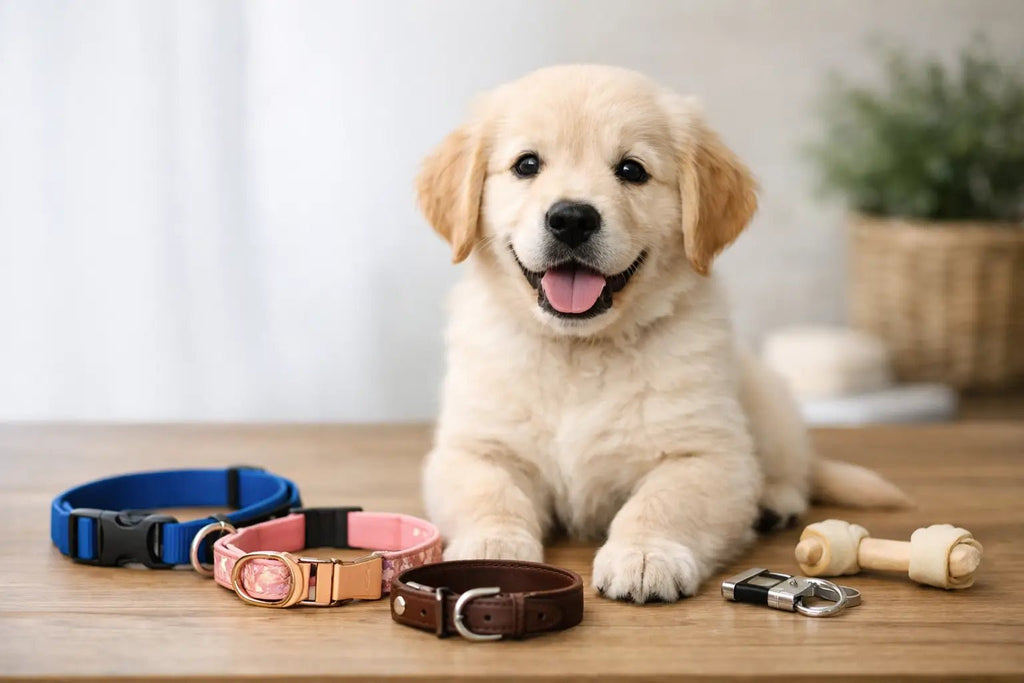
How to Choose Puppy Collar the Right Way
That tiny collar in your cart might look perfect, but if it rubs, slips, or feels too heavy on a growing puppy, it can turn a simple daily essential into a problem fast. If you are wondering how to choose puppy collar options that are safe, comfortable, and worth your money, the best place to start is with fit, then work outward to material, weight, and everyday use.
Puppies grow quickly, chew enthusiastically, and change a lot in just a few weeks. That means the best collar is rarely the fanciest one. It is the one your puppy can wear comfortably now, with enough room for adjustment, enough strength for safe walks, and enough softness for all-day wear around the house.
How to choose puppy collar for comfort first
Comfort matters more than most new dog parents expect. A collar sits against your puppy's neck every day, often for hours at a time. If it is stiff, bulky, or rough along the edges, your puppy will let you know by scratching, pawing, or trying to wriggle out of it.
Start by thinking about your puppy's size and age. A very young puppy usually does best with a lightweight collar that does not feel like a burden. Thick hardware and oversized buckles may look durable, but they can be too much for a small neck. For toy breeds and young puppies, lighter is usually better. For larger breeds, you still want comfort, but you may need a little more structure as your puppy gets stronger.
Width also matters. A collar that is too narrow can dig in, while one that is too wide can feel awkward and limit movement. In general, smaller puppies need narrower collars, while medium and large breed puppies can handle a bit more width. The collar should sit neatly on the neck without looking oversized or swallowing your puppy's frame.
Get the right size before anything else
If you only focus on one thing, make it sizing. The safest collar is one that stays on without being tight. Too loose, and your puppy can back out of it. Too tight, and it can cause discomfort, chafing, or trouble breathing.
Measure your puppy's neck with a soft tape measure where the collar will naturally rest. Then check the product sizing range instead of guessing by breed alone. Breed charts can help, but puppies vary a lot, especially mixed breeds.
Once the collar is on, use the two-finger rule. You should be able to fit two fingers comfortably between the collar and your puppy's neck. If you cannot, it is too tight. If it slides around excessively or slips over the head, it is too loose.
Because puppies grow so fast, an adjustable collar is usually the smartest buy. It gives you a little breathing room and helps you avoid replacing it too soon. Still, adjustable does not mean one-size-fits-all. If a collar is adjusted almost to its smallest or largest setting from day one, it is probably not the right size.
How often should you recheck the fit?
More often than you think. For young puppies, checking every week is a good habit. Growth spurts happen quickly, and a collar that fit perfectly two weeks ago may suddenly feel snug. If your puppy seems fussy with the collar, or you notice flattened fur, redness, or rubbing, check the fit right away.
Choose a puppy-safe material
The material affects comfort, durability, cleaning, and price. There is no single best option for every puppy because lifestyle plays a big role.
Nylon is one of the most practical choices for many pet parents. It is affordable, lightweight, easy to clean, and available in plenty of colors and patterns. For everyday use, nylon often gives the best balance of comfort and value. Just make sure the edges feel smooth and the stitching looks secure.
Soft fabric or padded collars can be a great pick for puppies with sensitive skin. They tend to feel gentler around the neck, especially during long wear. The trade-off is that they may hold onto moisture or odors a little more than simpler materials.
Leather can look great and last a long time, but it is not always the first choice for a very young puppy. It usually costs more, can feel heavier, and may require more care. If your puppy is still in the chewing-everything stage or gets into mud every afternoon, leather may not be the easiest option right now.
Water-resistant materials are helpful for active puppies who love puddles, beach trips, or messy backyard play. They are often easier to wipe clean and can be a practical option if you want less day-to-day maintenance.
The buckle and hardware matter more than the color
It is easy to shop by looks first, especially when puppy collars come in so many adorable styles. But the hardware does the real work.
A secure buckle should close firmly without being hard for you to use. Quick-release buckles are convenient and popular because they are simple to take on and off. Metal hardware often adds durability, but on very small puppies, it can add extra weight. Plastic hardware can be perfectly fine for smaller dogs if it feels sturdy and well-made.
The D-ring should be solid and attached securely. This is where tags and a leash clip will connect, so it should not feel flimsy or loose. If the stitching around the hardware looks weak, move on. A collar is not a place where bargain construction pays off.
Think about your puppy's daily routine
The best collar for a sleepy lap puppy may not be the best collar for a busy, high-energy explorer. Before you buy, picture your real day-to-day life.
If your puppy is mostly indoors and just starting short walks, a simple lightweight collar may be all you need. If your puppy is active, training regularly, or spending time outdoors, durability and easy cleaning become more important. If your puppy attends daycare or puppy classes, clear ID tags and a dependable closure matter even more.
This is where many pet parents overspend. They buy for what looks impressive instead of what fits their routine. A practical, comfortable collar that holds up well and adjusts with growth is often the better choice than a premium-style option that does not suit everyday life. At Souths Pet Supplys, that balance of comfort, quality, and value is exactly what many families are looking for.
How to choose puppy collar features you actually need
You do not need every extra feature, but a few can make life easier.
Reflective details are useful if you walk early in the morning or after dark. They add visibility without changing how the collar fits or feels. A personalized nameplate can reduce tag noise, though many pet parents still prefer traditional ID tags for flexibility. Soft padding can help if your puppy has short fur or sensitive skin.
What you usually do not need is a heavy training-style collar for a young puppy. Prong, choke, or overly corrective collars are not appropriate for basic puppy wear and can create safety and training problems. For most puppies, a standard flat collar is the right place to begin.
Collar or harness?
For many puppies, the answer is both, but for different jobs. A flat collar is great for carrying ID tags and for short, casual use. A harness is often better for leash walking, especially with small breeds, strong pullers, or puppies still learning not to lunge.
If your puppy pulls a lot, attaching the leash to a harness instead of the collar can reduce strain on the neck. That does not make the collar unnecessary. It just means the collar's main job may be identification and everyday wear rather than full walking control.
Watch for signs the collar is not working
Even a collar that looked perfect online can be wrong once your puppy starts wearing it. Pay attention during the first few days.
If your puppy scratches constantly, resists having the collar put on, develops hair loss around the neck, or seems uncomfortable after walks, something needs to change. Sometimes the problem is size. Sometimes it is the material or weight. And sometimes the collar is fine, but the leash pressure is too much and a harness would be the better walking tool.
It also helps to remove the collar regularly and check the skin underneath. Puppies with fluffy coats can hide rubbing or irritation until it becomes more obvious.
A smart puppy collar choice is simple
When pet parents ask how to choose puppy collar options without wasting money, the answer is usually less about style and more about thoughtful basics. Look for a collar that fits well today, adjusts for growth, feels soft against the neck, and matches your puppy's real routine.
Your puppy does not need the most expensive collar on the shelf to be happy, safe, and comfortable. A well-fitted, lightweight, dependable collar is often the best start - and a small choice that makes everyday pet parenting easier from the very beginning.
Related post
23
Jun
19
Jun
17
Jun
15
Jun
